“These words cover a building technique or a process of energy manipulation which brings into being a rapport between the Monad and a human being who is aspiring towards full liberation and is treading the path of discipleship and initiation; it can create a channel of light and life between the higher and the lower divine aspects and can produce a bridge between the world of spiritual life and the world of daily physical plane living.
It is a technique for producing the highest form of dualism and of eliminating the threefold expression of divinity, thereby intensifying the divine expression and bringing man nearer to his ultimate goal. Disciples must always remember that soul consciousness is an intermediate stage. It is also a process whereby – from the angle of the subhuman kingdoms in nature – humanity itself becomes the divine intermediary and the transmitter of spiritual energy to those lives whose stages of consciousness are below that of self-consciousness. Humanity becomes to these lives – in their totality – what the Hierarchy is to humanity.
This service only becomes possible when a sufficient number of the human race are distinguished by the knowledge of the higher duality and are increasingly soul-conscious and not just self-conscious. They can then make this transmission possible, and it is done by means of the antahkarana.


Number 1: Intention. By this is not meant a mental decision, wish or determination. The idea is more literally the focusing of energy upon the mental plane at the point of greatest possible tension. It signifies the bringing about of a condition in the disciple’s consciousness which is analogous to that of the Logos when – on His much vaster scale – He concentrated within a ring-pass-not (defining His desired sphere of influence) the energy-substance needed to carry out His purpose in manifesting. This the disciple must also do, gathering his forces (to use a common expression) into the highest point of his mental consciousness and holding them there in a state of absolute tension. You can now see the purpose lying behind some of the meditation processes and techniques as embodied in the words so often used in the meditation outlines: “raise the consciousness to the head center”; “hold the consciousness at the highest possible point”; “endeavor to hold the mind steady in the light”; and many similar phrases. They are all concerned with the task of bringing the disciple to the point where he can achieve the desired point of tension and of energy-focusing. This will enable him to begin the conscious task of constructing the antahkarana. It is this thought which really lies unrecognized behind the word “intention,” used so often by Roman Catholics and Anglo-Catholics when preparing candidates for communion. They indicate a different direction, however, for the orientation they desire is not that towards the Monad or spirit, but towards the soul, in an effort to bring about better character equipment in the personality and an intensification of the mystical approach.

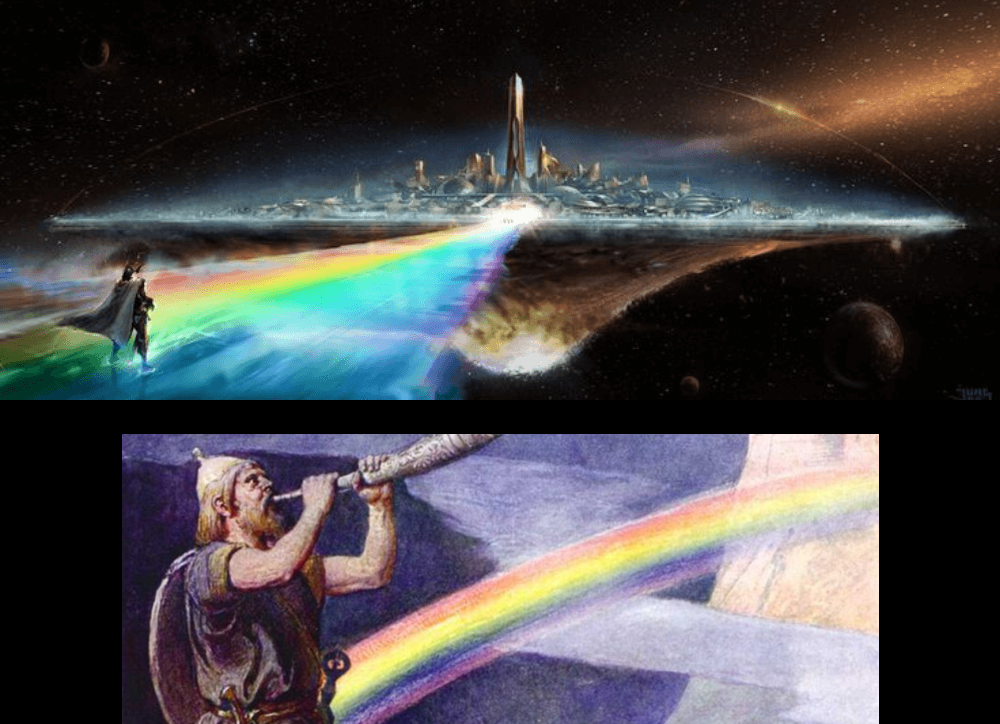
In the “intention” of the disciple who is consciously occupied with the rainbow bridge, the first necessary steps are:
The achievement of right orientation; and this must take place in two stages: first, towards the soul as one aspect of the building energy, and second, towards the Triad.
A mental understanding of the task to be carried out. This involves the use of the mind in two ways: responsiveness to buddhic or intuitional impression and an act of the creative imagination. A process of energy gathering or of force absorption, in order that the needed energies are confined within a mental ring-pass-not, prior to the later process of visualization and projection. A period of clear thinking , process and intention, so that the dedicated bridge-builder may clearly perceive what is being done.
The steady preservation of tension without undue physical strain upon the brain cells.
When this has been accomplished there will be found to be present a focal point of mental energy which previously had been non-existent; the mind will be held steady in the light, and there will also be the alignment of a receptive attentive personality and a soul oriented towards the personality and in a state of constant, directed perception. I would remind you that the soul (as it lives its own life on its own level of awareness) is not always constantly aware of its shadow, the personality, in the three worlds. When the antahkarana is being built, this awareness must be present alongside the intention of the personality.

Number 2: Visualization. Up to this point the activity has been of a mental nature. The creative imagination has been relatively quiescent; the disciple has been occupied within the mind and upon mental levels, and has “looked neither up nor down.” But now the right point of tension has been reached; the reservoir or pool of needed energy has been restrained within the carefully delimited ring-pass-not, and the bridge-builder is ready for the next step. He therefore proceeds at this point to construct the blueprint of the work to be done, by drawing upon the imagination and its faculties as they are to be found upon the highest level of his astral, or sensitive vehicle. This does not relate to the emotions. Imagination is, as you know, the lowest aspect of the intuition, and this fact must be remembered at all times. Sensitivity, as an expression of the astral body, is the opposite pole to buddhic sensitivity. The disciple has purified and refined his imaginative faculties so that they are now responsive to the impression of the buddhic principle or of the intuitive perception – perception, apart from sight or any recorded possible vision. According to the responsiveness of the astral vehicle to the buddhic impression, so will be the accuracy of the “plans” laid for the building of the antahkarana and the visualizing of the bridge of light in all its beauty and completeness.
The creative imagination has to be stepped up in its vibratory nature so that it can affect the “pool of energy” or the energy-substance which has been gathered for the building of the bridge. The creative activity of the imagination is the first organizing influence which works upon and within the ring-pass-not of accumulated energies, held in a state of tension by the “intention” of the disciple. Ponder upon this occult and significant statement.
The creative imagination is in the nature of an active energy, drawn up into relationship with the point of tension; it there and then produces effects in mental substance. The tension is thereby increased, and the more potent and the clearer the visualization process, the more beautiful and strong will be the bridge. Visualization is the process whereby the creative imagination is rendered active and becomes responsive to and attracted by the point of tension upon the mental plane.
At this stage the disciple is occupied with two energies: one, quiescent and held within a ring-pass-not, but at a point of extreme tension, and the other active, picture-forming, outgoing and responsive to the mind of the bridge-builder. In this connection it should be remembered that the second aspect of the divine Trinity is the form-building aspect, and thus, under the Law of Analogy, it is the second aspect of the personality and the second aspect of the Spiritual Triad which are becoming creatively active. The disciple is now proceeding with the second stage of his building work, and so the numerical significance will become apparent to you. He must work slowly at this point, picturing what he wants to do, why he has to do it, what are the stages of his work, what will be the resultant effects of his planned activity, and what are the materials with which he has to work. He endeavors to visualize the entire process, and by this means sets up a definite rapport (if successful) between the buddhic intuition and the creative imagination of the astral body. Consequently, you will have at this point:
The buddhic activity of impression.
The tension of the mental vehicle, as it holds the needed energy-substance at the point of projection.
The imaginative processes of the astral body.
When the disciple has trained himself to be consciously aware of the simultaneity of this threefold work, then it goes forward successfully and almost automatically. This he does through the power of visualization. A current of force is set up between these pairs of opposites (astral-buddhic) and – as it passes through the reservoir of force upon the mental plane – it produces an interior activity and an organization of the substance present. There then supervenes a steadily mounting potency, until the third stage is reached and the work passes out of the phase of subjectivity into that of objective reality – objective from the standpoint of the spiritual man.

- Projection. The task of the disciple has now reached a most critical point. Many aspirants reach this particular stage and – having developed a real capacity to visualize, and having therefore constructed by its means the desired form, and organized the substance which is to be employed in this later phase of the building process – find themselves unable to proceed any further. What then is the matter? Primarily, an inability to use the Will in the process of projection. This process is a combination of will, further and continued visualization, and the use of the ray Word of Power. Up to the present stage in the process, the method for all the seven rays is identical; but at this point there comes a change. Each disciple, having successfully organized the bridge substance, having brought into activity the will aspect, and being consciously aware of process and performance, proceeds now to move the organized substance forward, so that from the center of force which he has succeeded in accumulating there appears a line of light-substance or projection. This is sent forward upon a word of power, as in the logoic creative process. This is in reality a reversal of the process of the Monad when It sent forth the thread of life which finally anchored itself in the soul. The soul, in reality, came into being through the means of this anchoring; then came the later process, when the soul in its turn sent forth a dual thread which finally found anchorage in the head and the heart of the lower threefold man, the personality. The disciple is focused in the center which he has constructed upon the mental plane, and is drawing all his resources (those of the threefold personality and the soul combined) into activity; he now projects a line towards the Monad.
It is along this line that the final withdrawal of the forces takes place, the forces which – upon the downward way or the involutionary path – focused themselves in the personality and the soul. The antahkarana per se, completed by the bridge built by the disciple, is the final medium of abstraction or of the great withdrawal. It is with the antahkarana that the initiate is concerned in the fourth initiation, called sometimes the Great Renunciation – the renunciation or the withdrawal from form life, both personal and egoic. After this initiation neither of these aspects can hold the Monad any more. The “veil of the Temple” is rent in twain from the top to the bottom – that veil which separated the outer court (the personality life) from the holy place (the soul) and from the holy of holies (the Monad) in the temple at Jerusalem. The implications and the analogies will necessarily be clear to you.
In order, therefore, to bring about the needed projection of the accumulated energies, organized by the creative imagination and brought to a point of excessive tension by the focusing of the mental impulse (an aspect of the will), the disciple then calls upon the resources of his soul, stored up in what is technically called “the jewel in the lotus.” This is the anchorage of the Monad – a point which must not be forgotten. The aspects of the soul which we call knowledge, love and sacrifice, and which are expressions of the causal body, are only effects of this monadic radiation.
Therefore, before the bridge can be truly built and “projected on the upward way, providing safe travelling for the pilgrim’s weary feet” (as the Old Commentary puts it), the disciple must begin to react in response to the closed lotus bud or jewel at the center of the opened lotus. This he does when the sacrifice petals of the egoic lotus are assuming control in his life, when his knowledge is being transmuted into wisdom, and his love for the whole is growing; to these is being added the “power to renounce.” These three egoic qualities – when functioning with a measure of potency – produce an increased activity at the very center of soul life, the heart of the lotus. It should be remembered that the correspondences in the egoic lotus to the three planetary centers are as follows:
Shamballa – The jewel in the lotus.
Hierarchy – The three groups of petals.
Humanity – The three permanent atoms within the aura of the lotus.

Students should also bear in mind that they need to rid themselves of the usual idea of sacrifice as a process of giving-up, or renunciation of all that makes life worth living. Sacrifice is, technically speaking, the achievement of a state of bliss and of ecstasy because it is the realization of another divine aspect, hidden hitherto by both the soul and the personality. It is understanding and recognition of the will-to-good which made creation possible and inevitable, and which was the true cause of manifestation. Ponder on this, for it is very different in its significance to the usual concepts of sacrifice.
When the disciple has gained the fruit of experience which is knowledge and is learning to transmute it into wisdom, when his objective is to live truly and in reality, and when the will-to-good is the crowning goal of his daily life, then he can begin to evoke the will. This will make the link between the lower and the higher minds, between spirit and matter and between monad and personality a definite and existent fact. Duality then supervenes upon triplicity, and the potency of the central nucleus in the egoic vehicle destroys – at the fourth initiation – the three surrounding expressions. They disappear, and then the so-called destruction of the causal body has taken place. This is the true “second death” – death to form altogether.
This is practically all that I can tell you about the process of projection. It is a living process, growing out of the conscious daily experience and dependent upon the expression of the divine aspects in the life upon the physical plane, as far as is possible. Where there is an attempt to approximate the personality life to the demands of the soul and to use the intellect on behalf of humanity, love is beginning to control; and then the significance of the “divine sacrifice” is increasingly understood and becomes a natural, spontaneous expression of individual intention. Then it becomes possible to project the bridge. The vibration is then set up on lower levels of divine manifestation and becomes strong enough to produce response from the higher. Then, when the Word of Power is known and rightly used, the bridge is rapidly built.

Students need feel in no way discouraged by this. Much can happen on the inner planes where there is right intention, as well as occult intention (purpose and tension combined), and the bridge reaches stages of definite outline and structure long before the disciple is aware of it.”
Truly, perhaps enlightenment is next!!